

Lughnasadh is the Gaelic word for August and clearly related to the Sun God Lugh – in Celtic mythology he was one of the most important Gods, because without sun there would be no life on earth; you may also be familiar with the medieval Christian word for this time of year, Lammas. This ancient celebration used to take place throughout the whole month of August.
At Lughnasadh we celebrate the marriage of Lugh to his Goddess and the gifts that they bring to earth. Lugh is one of the many names of the highest God who at this time of the year is seen as the God of the ripening corn, of the coming harvest. It is a time of fertility, the crops are ripening, the young of the animal world have been born and are thriving, and the flowers are beginning to become fruit on the trees.
There were great Lughnasadh gatherings where people sold their produce and relaxed and celebrated before the hard work of the harvest began. We can see the remnants of these in the fairs that still take place in various towns in the Celtic lands.
In Ireland Lughnasadh games were famous, they were held to commemorate the death of Lugh’s foster mother Taillte who died of exhaustion after clearing a large area of land so that the people could cultivate it. On her death bed she asked that games would be held in her honour each year, promising that song would remain in Ireland if this was done. Lugh is also associated with ploughing and sowing so we see the connection with the bringing of the knowledge of agriculture and the sacrifice of both the earth mother and the god for the continuing life of their children.
Probably more relevant to our time is that Lugh is known as the Samildánach – “the man of each and every art”; Lughnasadh is a gathering time for people of all the arts, crafts and professions; at this critical time for the earth such a gathering could be of immense value in terms of demonstrating new and old skills that would benefit the earth and all her children.
Lughnasadh is the last of the four fire festivals on the wheel of the year and the culmination of them, just as the summer solstice is the high point of the four astronomical celebrations of the solstices and equinoxes. At the summer solstice the sun reached its highest point and in that moment began his descent towards the autumn equinox. At Lughnasadh the sun is still high in the sky, at his brightest but already descending in fiery glory towards Autumn – this is the season of the most glorious sunsets.
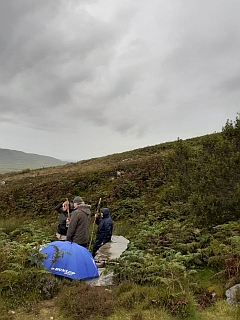
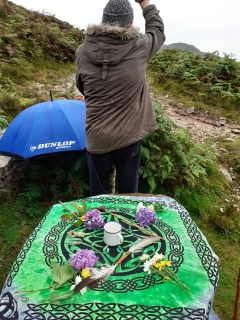
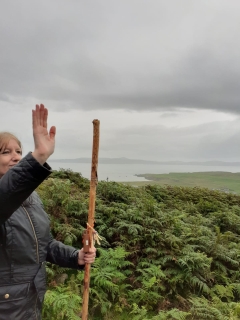
A Greeting from our friends from New Zealand:
 |
 |
 |
 |
 |
A video impression from a Lughnasad Celebration at Guthausen Germany:
Samhain is the time of no time and the end and beginning of the Celtic year. For three days the doors between the worlds are open and chaos may rule.
Out of the chaos comes the new order of the new year. It is a time to re-member, to bring together again, the best of our past, individually and collectively. It is a time to remember our loved ones who have already crossed the threshold and those ancestors whose lives and work prepared the way for us to incarnate in this land.
Samhain brings the opportunity to review the past cycle of life, if we can do this very honestly we may be able to move to a new state of being – we strive towards compassion for all life, to preserve the dignity of human beings, to protect the earth and to learn to give without expectation.
The Celts recognised God in His Stag form; Cernunnos is God in His own creation, He is the hunter and gatherer of souls, in later times known as the good shepherd who forgets no one, all are brought home.
Imbolc, Oimelc, Imbolcu, are ancient names for the ceremony that was dedicated to the Goddess Brighid.
In Ireland there were Women Druids (Ban Draoithe) who tended a sacred flame in her name at a sacred place in Co. Kildare. This Goddess was later Christianised to become St. Brighid of Kildare whose nuns kept the perpetual flame burning. The many prayers, blessings, and invocations to Brighid are mostly related to this Christian saint.
Brighid, saint and Goddess, is much loved in Ireland, Scotland and other Celtic lands where she is known as Bride, Bridge, Brigantia and Riganta. She is Goddess of smith craft, of fire, of the hearth, a midwife and carer of mothers and children; she is patroness of poets and a goddess of the threshold.
In earlier times Imbolc was a festival and ceremony related to the Goddess Brighid marking the very first stirrings of life after the dark and barren winter. The quickening of the earth has become noticeable in the appearance of the first snowdrops and the coming of the milk in pregnant ewes just before the birth of their lambs.
Very often we have a foretaste of spring in these early days of February, mild weather and sunshine cheer us with the promise of the approach of winters end. This usually last only a few days and winter returns with gales and snow before it finally gives way to the rising sun and the return of spring.
Brighid is one aspect of the primal Goddess Danu who is the great Mother Goddess of the Celts and bears the triple aspects of maiden, mother and crone or wise woman. Brighid is the maiden and bringer of new life. Danu is the mother in her fullness and the cailleach or the Morrigan (Great Queen) is the wise woman or crone. The Morrigan has been feared as a harbinger of death, and war however she is the one guides us across the threshold into the other world when it is time for us to leave off our earthly bodies.
At Imbolc the Cailleach or woman of winter gives way to Brighid bringer of spring. In some traditions Brighid is portrayed as having one side of her face fresh and clear as a maiden and the other side is wrinkled and old like a crone. This indicates that these two Goddesses are really one and the same but showing different aspects or attributes.
Bealtaine (also the Gaelic word for the month of May) means Bright Fire and was probably named after the God Bel, known also as Belenos whose name means “bright” or “brilliant”. He was associated with the sun and with fire; Bealtaine or Bright Fires are still lit in some parts of Ireland and Scotland.
In times gone by two fires would have been lit on a hill top as the sun set below the horizon on Bealtaine eve, there would have been music and dancing and celebration for the coming of the Goddess of spring. The cattle were driven between the fires to bring protection for their health and fertility; people also ran between the Bright Fires for similar reasons, pregnant woman would run through the fires in the hope of an easy birth.
It was a time to celebrate the fertility of the earth, the animals and the people, and these festivities often culminated in much joyful lovemaking in the woods.
At Beltaine the young Goddess who returned to us as the maiden Brighid at Imbolc now comes to Her marriage or union with the young God. In ancient times two fires were lit in honour of their sacred union and at this time all of nature, the gods and the heavens celebrate this cosmic event that brings renewed Life to Earth.
The Bealtaine ceremony honours the Goddess and the God through the symbols of water and stone. At this time heaven and earth come together in Holy Union and new Life is created.
The two fires are lit, one for the God and one for the Goddess. Now is the time to offer up all that needs to be cleansed, released and purified, to make room for everything good and new.
The elemental beings and their role in the fertility and well-being of the earth are recognised. The energy of the Rite is dedicated to the healing and renewal of the earth and all the kingdoms of nature.
As Bealtaine heralds the spring of the year, this time at the beginning of the 21st century heralds the Spring of the Age of Aquarius. The elemental beings are calling us away from our destructive lifestyles; their voices can be heard in the earthquakes, in the great floods, through storms, lightning and thunder, through fire of the sky and fire of the earth. God calls upon us to protect the stones, the waters, the trees and the animals – every part of nature.
Beltaine provides us with the opportunity to join in the cosmic celebration, to leave behind our materialistic ideas and enter once more into the creative cycle of heaven and earth.


